Can You Take Nonlinear Control Before Continuous Control Reddit
Is It Safe to Delay a Second COVID Vaccine Dose?
Some evidence indicates that short waits are safe, only there is a run a risk that partial immunization could aid risky new coronavirus variants to develop
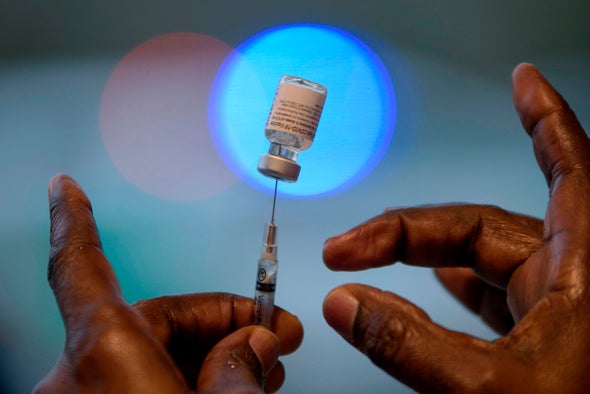
Vaccine shortages and distribution delays are hampering efforts to adjourn the SARS-CoV-2 pandemic. So some scientists have suggested postponing the second shots of ii-dose vaccines to make more than available for people to go their commencement doses. The original recommended interval was 21 days between doses for the Pfizer vaccine and 28 days for the Moderna shots, the two currently authorized in the U.S. Now the U.South. Centers for Illness Control and Prevention has updated its guidance to say that people can look up to 42 days between doses, though the bureau still advises individuals to stick to the initial schedule. And developers of the University of Oxford–AstraZeneca vaccine—which is authorized for employ in the U.K.—suggest fifty-fifty longer stretches are possible, saying their shot performs meliorate when its doses are spaced 12 weeks apart. Their data is in a new preprint paper, released before peer review. And so what gives? How long can you lot get on a unmarried shot and still stay safe? And what happens if your second shot isn't available on time? Scientific American explores the potential risks and benefits of delaying vaccine doses.
Why do you need two shots?
Vaccines are designed to create immunological memory, which gives our immune system the power to recognize and fend off invading foes fifty-fifty if we have not encountered them before. Almost COVID vaccines arm-twist this response by presenting the immune organization with copies of the novel coronavirus'due south spike proteins, which adorn its surface like a crown.
Two-shot vaccinations aim for maximum benefit: the showtime dose primes immunological retentivity, and the second dose solidifies it, says Thomas Denny, main operating officer of the Duke Human Vaccine Institute. "Yous tin think of it like a gradient," he adds. I dose of the Pfizer vaccine can reduce the average person's take chances of getting a symptomatic infection past about 50 percent, and ane dose of the Moderna shot tin do so by about eighty percent. 2 doses of either vaccine lowers the risk by about 95 percent.
Why does the CDC at present allow up to 42 days between doses of the Pfizer and Moderna vaccines?
The agency updated its initial guidance after it received feedback that some flexibility might exist helpful to people, especially if there are challenges around returning on a specific date, says CDC spokesperson Kristen Nordlund. While the U.K. is recommending dose stretching equally a deliberate strategy to get more first shots in more arms, the CDC is suggesting it as an selection to make scheduling second shots less onerous. In the U.S., the vaccine rollout has been painfully slow: two months after the get-go shots were given to the public, only most iii percentage of the population has received both doses of a vaccine. And equally vaccine producers struggle to go on up with need, experts believe some compromises are necessary to ensure people are fully vaccinated. "We need to make the best conclusion with the resources we have," says Katherine Poehling, a pediatrician at Wake Woods Baptist Wellness, who is on the CDC's Advisory Committee on Immunization Practices. "If there'south plentiful vaccine, it might take a different approach than if the vaccine is limited.... Simply you practise need the 2d dose."
What kind of protection practise you accept until twenty-four hour period 42?
Co-ordinate to data from the Pfizer and Moderna trials, protection kicked in near 14 days after the beginning dose, when the curve showing the number of infections in the nonvaccinated group kept swinging upward while the curve for the vaccinated grouping did not. For both vaccines, a single shot protected near everyone from astringent disease and, as noted, was almost 50 percent (Pfizer) or 80 percent (Moderna) effective in preventing COVID altogether. Though most trial participants received their second vaccine on solar day 21 or 28, some waited until solar day 42, or fifty-fifty longer. The number of outliers is too small to draw definitive conclusions about the impact of prolonging the two-shot regime, even so. For instance, of 15,208 trial participants who received the Moderna vaccine, only 81 (0.5 percent) received it outside the recommended window.
"Nosotros don't have the greatest science, at this indicate, to say we are 100 percent comfortable doing a booster 35, twoscore days out," Denny says. "We are deferring to the public health concerns and the belief that anything nosotros tin practise right now is improve than nothing."
If people are only partially immunized with i dose, could that fuel more unsafe coronavirus variants?
That is a existent business organization, according to Paul Bieniasz, a retrovirologist at the Rockefeller University. Early on in the pandemic, there was little pressure on the novel coronavirus to evolve because nobody's immune arrangement was primed against infection, and the microbe had piece of cake pickings. But now millions of people have go infected and accept developed antibodies, then mutations that give the virus a way to evade those defenses are rising to prominence. "The virus is going to evolve in response to antibodies, irrespective of how we administrate vaccines," Bieniasz says. "The question is: Would we be accelerating that evolution by creating state-sized populations of individuals with fractional immunity?"
Just as not finishing your entire class of antibiotics could help to fuel antibody-resistant bacteria, non getting fully vaccinated could turn your torso into a breeding ground for antibody-resistant viruses. But Trevor Bedford, a computational biologist at the Fred Hutchinson Cancer Research Centre who tracks viral mutations, has tweeted that the step of evolution is not only adamant past the weakness or force of the immune system. It is also affected by the sheer number of viruses circulating in the population, he wrote. Without widespread immunizations, the latter amount—and the number of variants that might beget a more formidable virus—will continue to grow.
Could a longer interval betwixt showtime and second doses make a COVID vaccine more constructive?
That result is possible. All COVID vaccines are not created equal, and the optimal dosing schedule depends on the specific design. Some vaccines are based on fragile strips of genetic material known as mRNA, some rely on hardier Deoxyribonucleic acid, and others use poly peptide fragments. These cores tin can be carried into a prison cell sheathed in a tiny lipid droplet or a harmless chimpanzee virus.
Given such differences, Denny is not surprised that the Dna-based Oxford-AstraZeneca vaccine was tested and found effective with a space of 12 weeks between shots. That is about three to four times longer than the recommended intervals of the mRNA-based Moderna and Pfizer vaccines. In time, researchers may find that dosing schedules that are slightly different from the ones tested in the kickoff clinical trials are more effective. "Yous could take done dosing studies for 2 years, but that would not be the most responsible matter to do in a world like this," Denny says. "Don't let the perfect be the enemy of the good."
The author would like to acknowledge Rachel Lance for suggesting a source of data that was included in the story.
Read more virtually the coronavirus outbreak from Scientific American here. And read coverage from our international network of magazines here.

Source: https://www.scientificamerican.com/article/is-it-safe-to-delay-a-second-covid-vaccine-dose/
0 Response to "Can You Take Nonlinear Control Before Continuous Control Reddit"
Enregistrer un commentaire